Written by: Alec Bigras
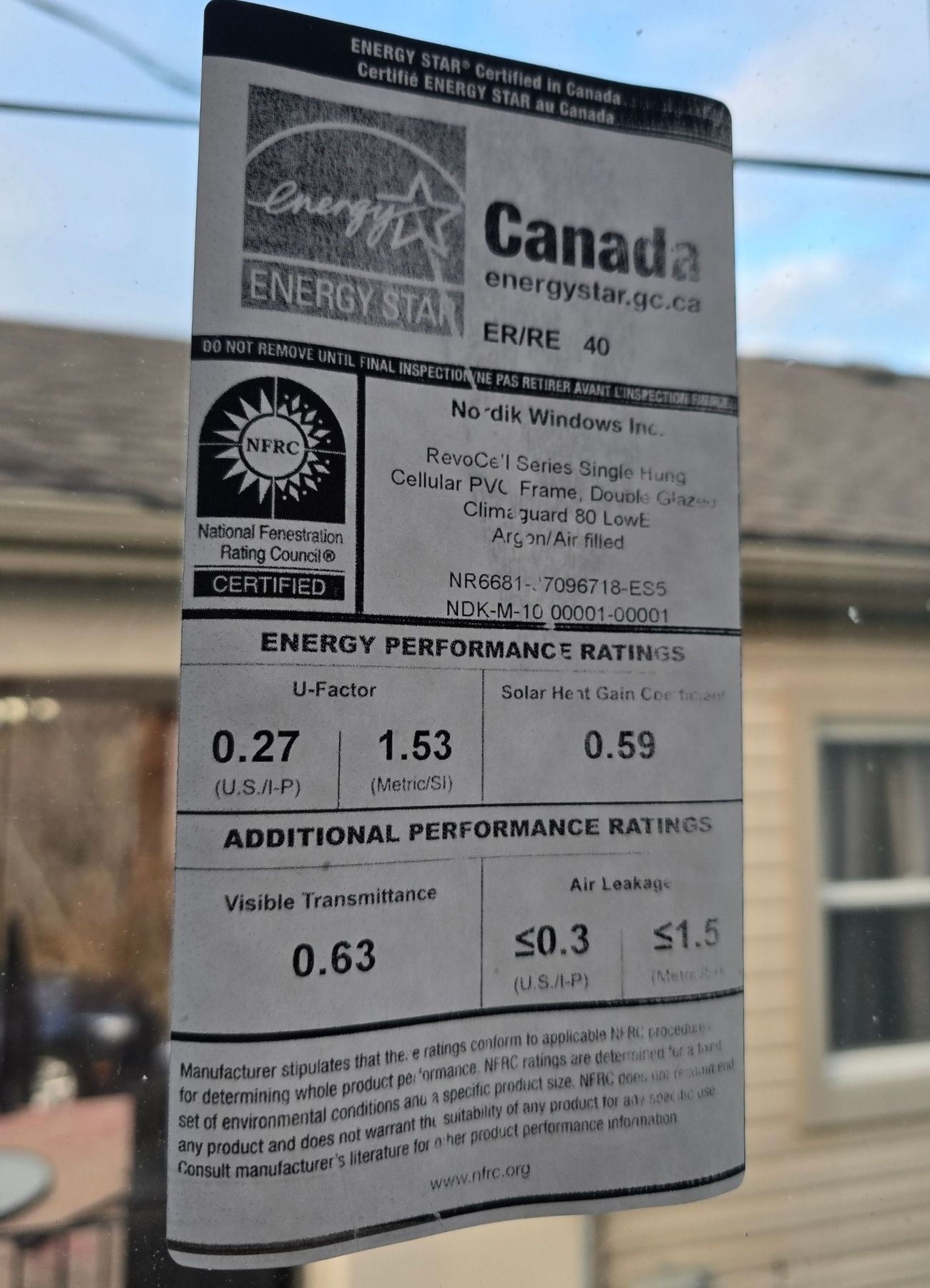
Reviewer: Editorial TeamSomewhere between the sales pitch and the sticker on the glass, "ENERGY STAR certified" turns into one of those phrases everybody says and nobody explains.
So let's actually explain it, with no sales script. Just the straight and honest answer every Ottawa homeowner deserves before they sign anything.
What it certifies: the window was tested and meets Natural Resources Canada's (NRCan) efficiency threshold for our climate zone. That threshold is expressed one of two ways: an Energy Rating (ER), which is a single score combining how well a window insulates, blocks air leaks, and uses sunlight for heat (higher is better), or a U-factor, which measures how much heat escapes through the window (lower is better). To certify, a window needs an ER of 34 or higher, or a U-factor of 1.22 W/m²·K (0.21 in imperial) or lower.
How to check a specific window: look it up on NRCan's public, searchable product list by manufacturer and model.
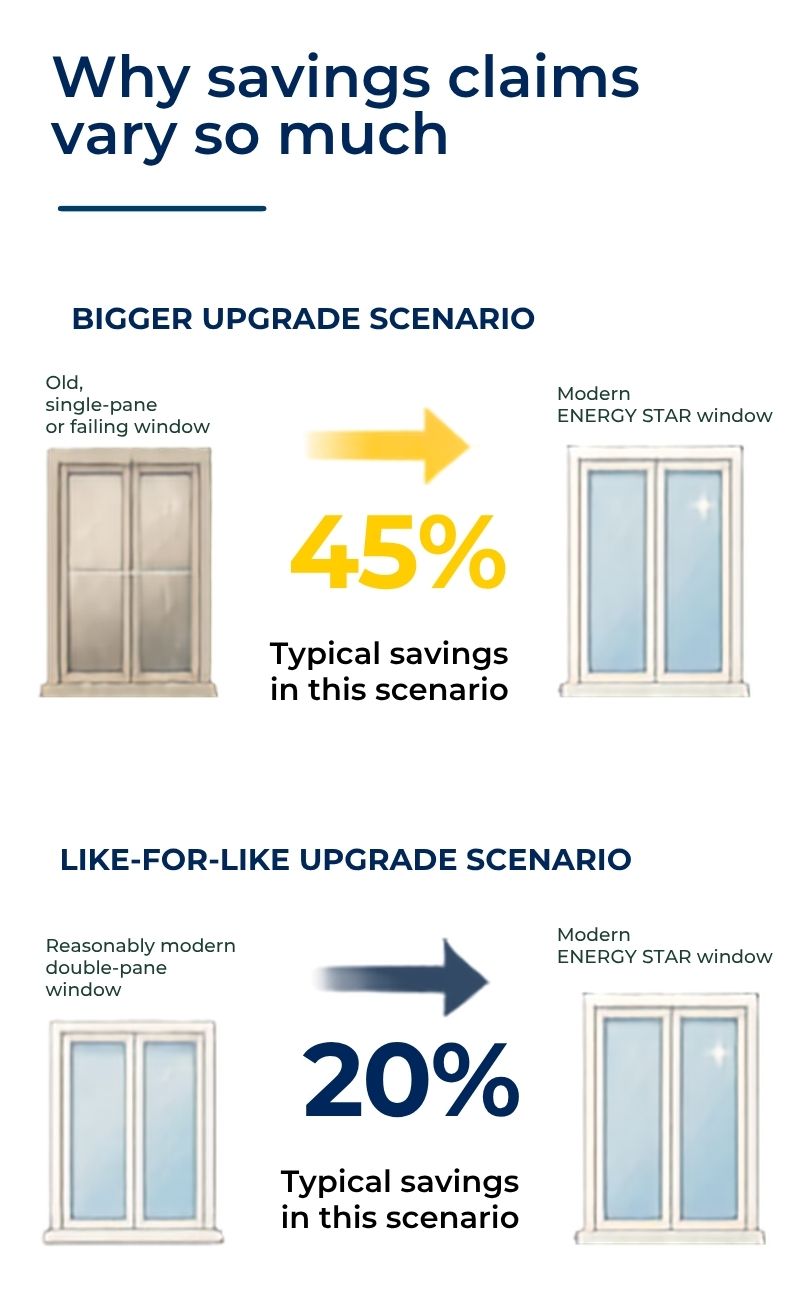
Worth it? NRCan puts certified windows at roughly 20% more efficient than the average window on the market. You'll see bigger claims elsewhere (up to 45%) and we'll show you exactly what those numbers are assuming below.
What ENERGY STAR certification actually means
ENERGY STAR isn't a marketing badge a company can simply print and stick on. It's a performance threshold, and a window either clears it under testing or it doesn't.
Who tests and certifies it
Windows don't grade their own homework. Manufacturers send their products to accredited third-party labs, where they're tested against national standards, the same testing infrastructure that feeds both the NRCan product list and the National Fenestration Rating Council (NFRC) database. The results are public, so anyone can check them.
ENERGY STAR in Canada vs. the United States
The U.S. ENERGY STAR program doesn't use ER at all. It reports U-factor and Solar Heat Gain Coefficient (SHGC) separately, across four U.S. climate zones. Canada combines those same underlying measurements (U-factor, SHGC, and air leakage) into one single ER score, across three zones calibrated to our colder winters. It's the same testing, just reported and scored differently.
So if a savings claim references energystar.gov, it's describing a different set of pass marks, sized for American climate zones, than the one your window needs to clear here in Canada.
What it doesn't cover
Here's the part almost nobody says out loud: certification rates the window unit, not the installation. A window with a great ER number, installed with a sloppy air seal or the wrong flashing, will underperform (sometimes very badly). The label tells you what the product is capable of, but it doesn't tell you whether the crew that put it in your wall did the job right.
The requirements in Canada
To carry the ENERGY STAR label in Canada, a window has to hit one of two equivalent measures:
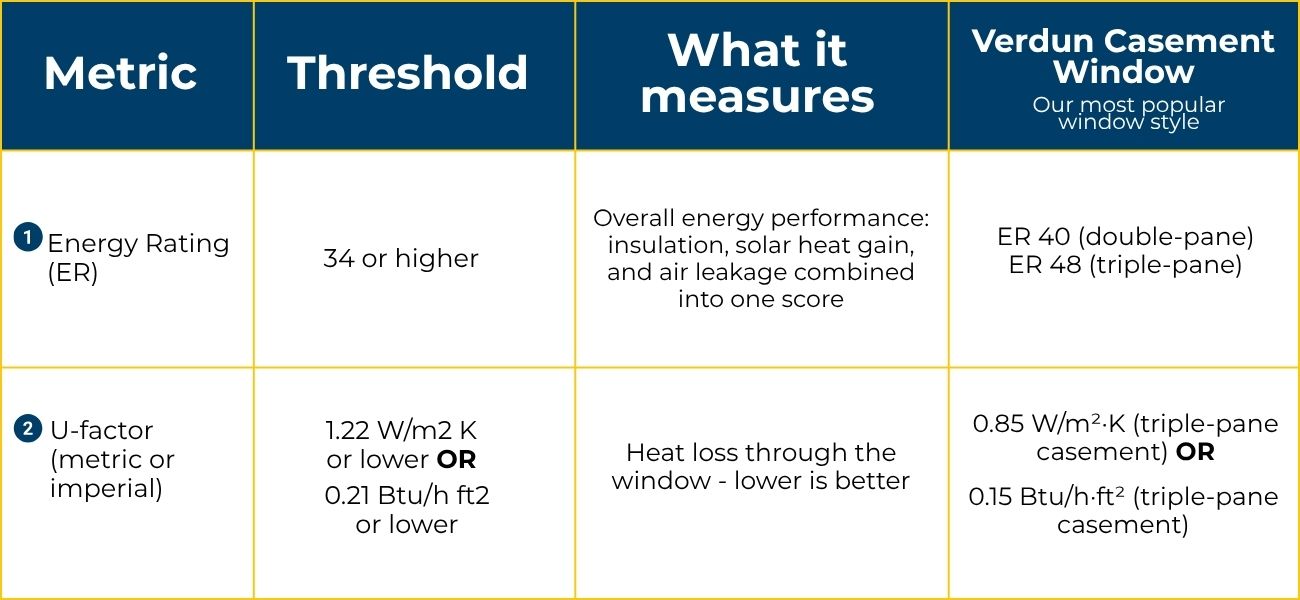
Why you'll see 0.21 and 1.22 quoted for the same thing
NRCan's official listings state the requirement in metric (1.22 W/m²·K). But plenty of companies, and plenty of Canadian homeowners, think in imperial. So you'll see the same threshold written two different ways depending on where you're reading it (sometimes 1.22, sometimes 0.21) with no mention that they're actually the same number. They're not wrong. They're just different units.
Here's the missing piece: 1.22 W/m²·K and 0.21 Btu/h·ft²·°F are the same requirement, just measured on two different rulers: one metric, one imperial.
ENERGY STAR vs. ENERGY STAR Most Efficient
Baseline ENERGY STAR certification is the entry bar, and ENERGY STAR Most Efficient is the tier above it. Most efficient is a smaller list of products NRCan recognizes as the best-performing options certified that year, revisited annually. It's not a permanent certification, it's re-earned every year.
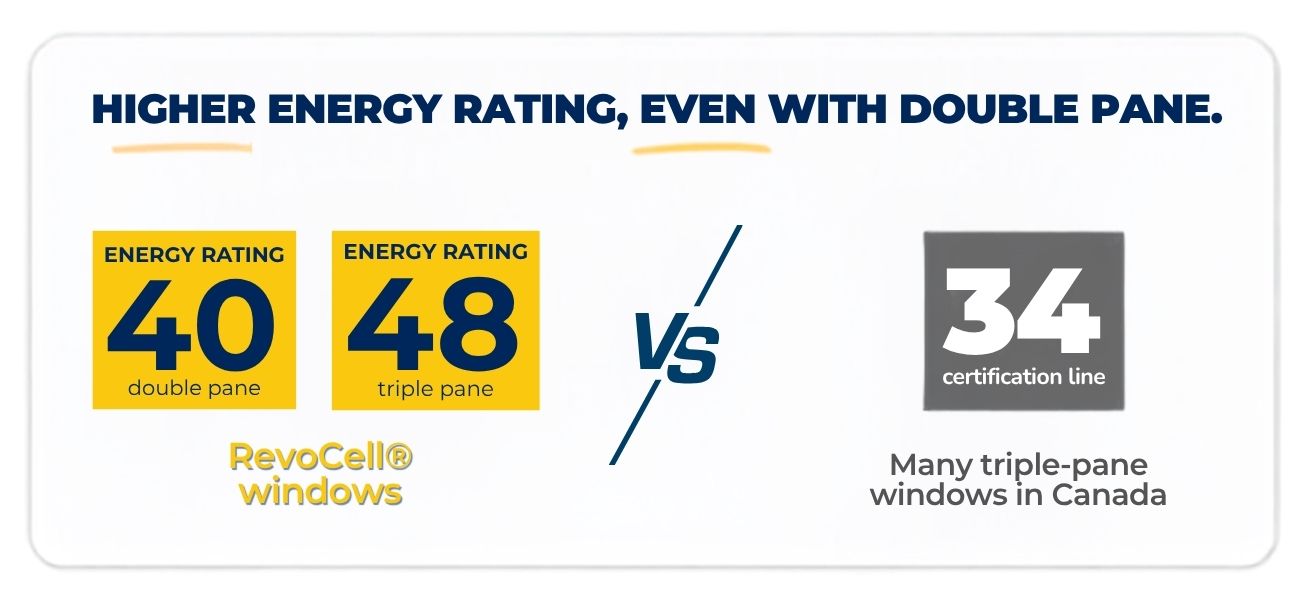
Our RevoCell® windows are built on a solid-core microcellular PVC frame rather than the hollow-chambered PVC most of the industry still uses. In fact, even in a standard double-pane configuration, RevoCell® carries a higher Energy Rating than many triple-pane windows currently sold in Canada.
In standard triple-pane configuration, RevoCell® casement and awning windows test at ER 48, which is well clear of the ER 34 certification line. This is why they carry ENERGY STAR Most Efficient designation.
How to check whether a window is actually certified
This is the part that actually matters if you're mid-quote right now, so here's the walkthrough.
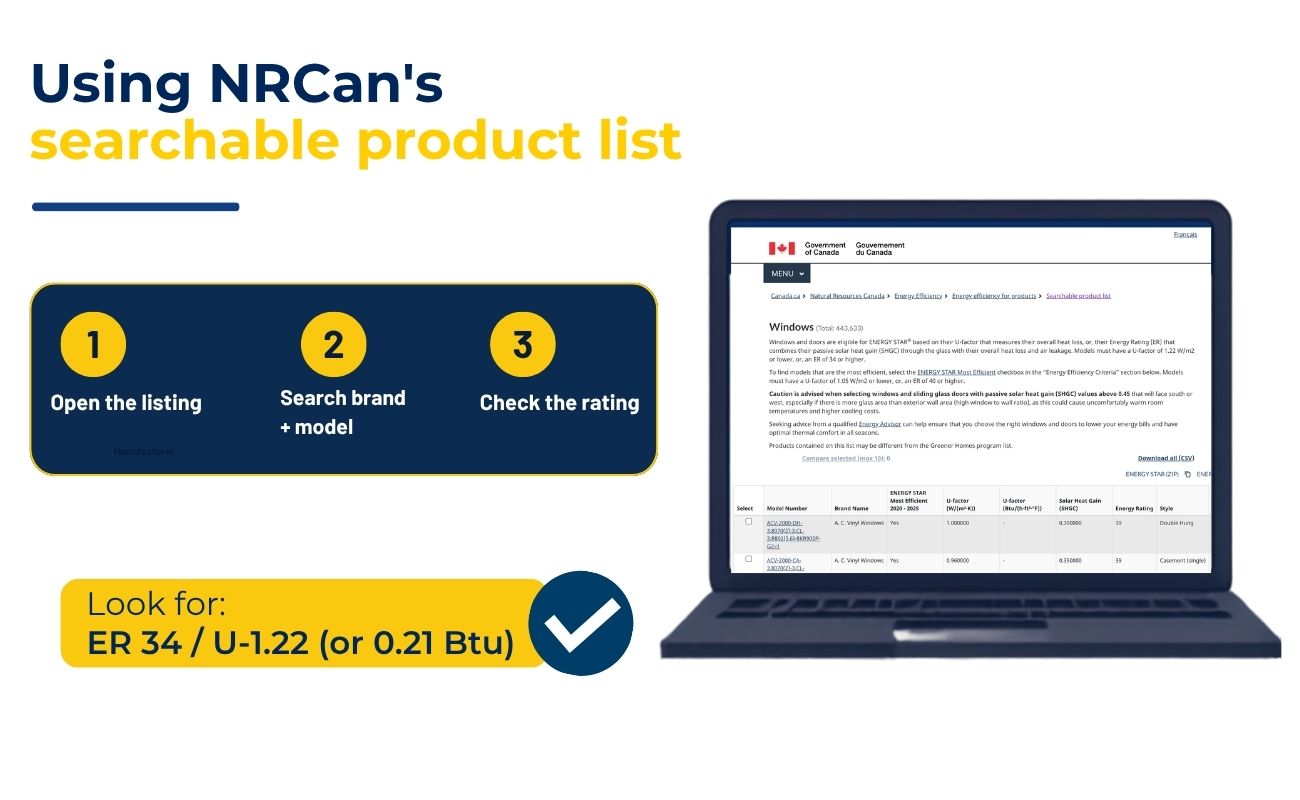
Using NRCan's searchable product list
NRCan maintains a free, public database of every certified window, door, and skylight in Canada, searchable by manufacturer and model. Pull up the listing, search the brand you're being quoted, and confirm that the specific model and configuration you're being sold (not just the brand name) actually appears with a rating that clears ER 34 / U-1.22 (or 0.21 Btu) . If it's not there, that's a conversation worth having before you sign anything.
What to ask a salespersonThree fair questions, and a company that's confident in its numbers won't flinch at any of them:
- "Can you show me this exact model on NRCan's list?"
- "Is that the ER number for this glass package, or a different configuration?"
- "Is this ENERGY STAR, or ENERGY STAR Most Efficient, and for what year?"
That last one matters more than it sounds. As mentioned above, Most Efficient is an annual designation, not a lifetime one.
What if there's no label on the window?
Labels can peel, get painted over, or simply never get applied correctly during install. A missing sticker doesn't automatically mean a window isn't certified, but it does mean you should check the database rather than take anyone's word for it, ours included. We'd rather you verify it so you can feel confident in your window.
Are ENERGY STAR windows worth it?
Short answer: yes, but the number that proves it depends on what you're comparing it to. Let's separate the honest figure from the eye-catching one.
What the numbers actually say
NRCan's own figure is that ENERGY STAR certified windows are roughly 20% more efficient than an average window. That's the defensible, Canadian, apples-to-apples number.
Why savings claims vary so much
You'll see bigger figures floating around (45% shows up a lot). That number isn't fabricated; it's just answering a different question. It typically assumes you're replacing very old, single-pane, or failing windows, where almost anything newer is a dramatic upgrade.
If you're replacing a reasonably modern double-pane window, 20% is the more honest expectation. We'd rather tell you the accurate number than the exciting one.
When certification matters most in an Ottawa winter
Ottawa–Gatineau doesn't do "mild”. We get deep cold snaps, big humidity swings, and the kind of wind chill that finds every weak point in a wall. That's exactly the climate that ER and U-factor were built to model, and it's why the Canadian threshold is stricter than the American one. A certified window isn't just a ‘nice-to-have’, it's the baseline for a home that doesn't cause you problems every February.
Frequently Asked Questions
Is ENERGY STAR just a sticker every manufacturer buys?
No. It requires independent lab testing against a fixed technical standard, and every certified product is listed on a public database you can check yourself.
Here's what that actually looks like at Verdun: once our windows complete testing, the results go to an independent certification agency, who reports them to NRCan to update the database. That's what generates our NRCan reference number, the one that confirms a specific window is genuinely ENERGY STAR certified. And it's worth knowing that NRCan's database only lists windows that are certified. If a company can't point you to their listing, they’re likely not ENERGY STAR certified
Do all Verdun windows meet the ENERGY STAR threshold?
Verdun’s RevoCell® windows (in standard configuration) are engineered well past the ER 34 / U-1.22 minimum, and our line carries the ENERGY STAR Most Efficient designation. Ask us for the specific NRCan listing for your model and configuration so we can show you.
Are Canadian and American ENERGY STAR windows the same thing?
No. They share a name and a general idea, but the Canadian threshold is calibrated to our colder climate and is harder to meet than the U.S. standard.
What's the difference between ENERGY STAR and ENERGY STAR Most Efficient?
ENERGY STAR is the certification floor. Most Efficient is a smaller, tougher, annually-reviewed tier above it that recognizes the top-performing products certified that year.
My old windows don't have a visible label anymore — does that mean they're not efficient?
Not necessarily, but you can't tell from the missing sticker either way. If efficiency is the question, the honest next step is a quote and an ER conversation, not a guess.
About Verdun
Verdun Windows & Doors by Nordik has been manufacturing and installing windows and doors for Ottawa and Gatineau homeowners for over 40 years. Every product is custom-built in Canada, every installation is managed by one accountable team from start to finish, and every job is backed by the 25-Year No-Bull Warranty, covering product, parts, labour, and installation with no fine print.