Written by: Alec Bigras
Reviewer: Editorial TeamWhether you've spotted the term on a quote, seen it listed on a product page, or you're just curious what your neighbour has on the side of their house, casement windows deserve a proper introduction.
So let's talk about what they are, why Ontario homeowners keep choosing them, and all the information you actually need to know before you buy.
What Is a Casement Window?
A casement window is a window that's hinged on one side (usually left or right) and swings outward like a door. The entire sash opens, which is part of why casements are such strong performers on ventilation.
What really makes casements genuinely impressive is the close. When the sash shuts, it compresses against the frame on all four sides at once. That compression seal is why casements are among the top performers for energy efficiency.
They also come in several styles, so whatever your home looks like, there's a casement that fits.
Types of Casement Windows
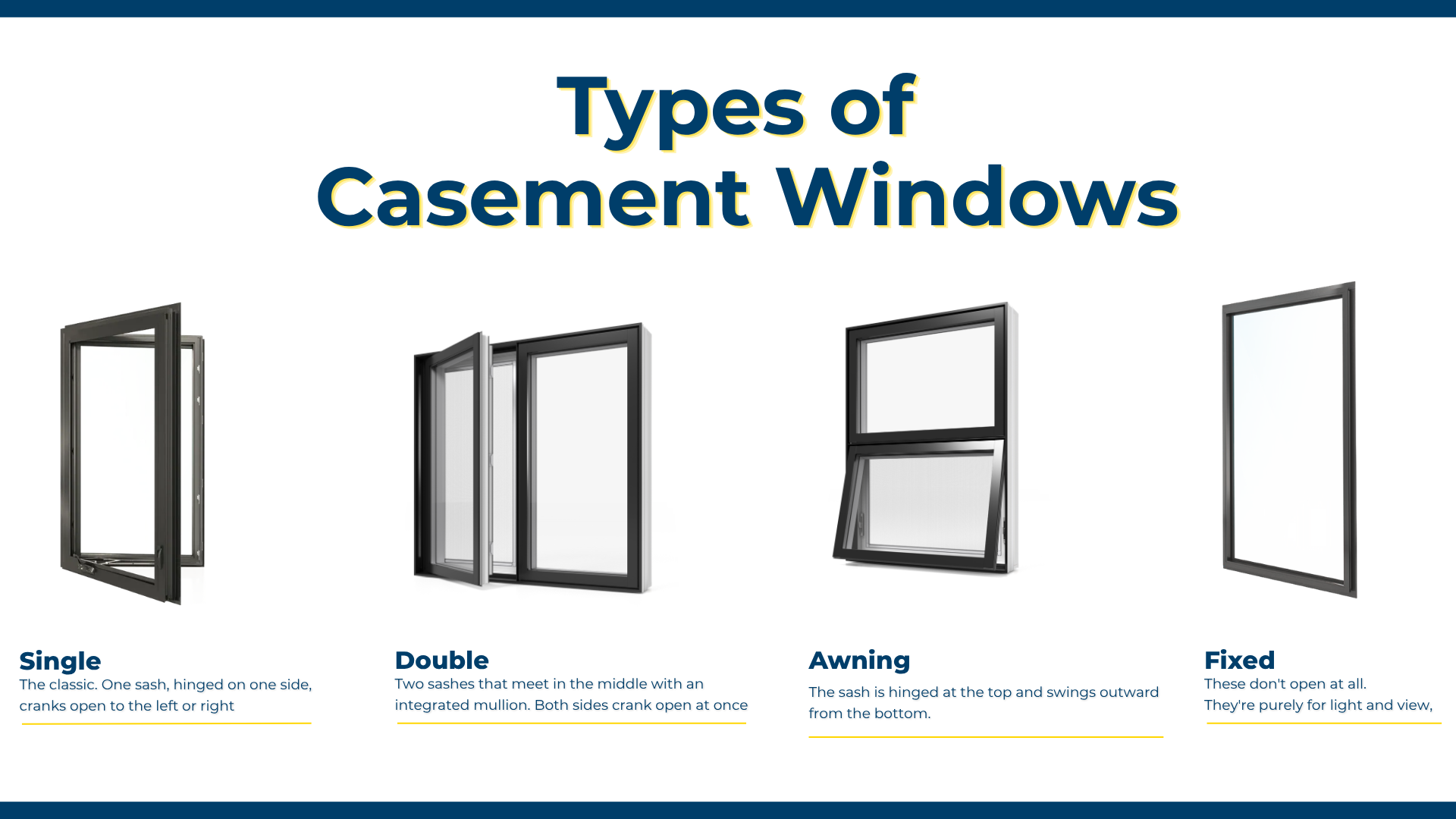
Not all casement windows are built the same way or do the same job. At Verdun, there are four main casement window styles. The differences between each of them is definitely worth knowing, especially before you decide what goes where in your home.
Single Casement Windows
The classic. One sash, hinged on one side, cranks open to the left or right. Works in just about any room and any opening size. This is what most people picture when they hear "casement window."
Double Casement Windows (French Casement)
Two sashes that meet in the middle with an integrated mullion. Both sides crank open at once, giving you a wide-open, unobstructed view.
These are very popular in living rooms and above kitchen sinks, where you'd want maximum airflow and a clean view. They also just look elegant.
Top-Hung Casement Windows
Also called awning-style casements, the sash is hinged at the top and swings outward from the bottom.
The big advantage? You can leave these open during light rain without water getting in. This style is great for bathrooms, kitchens, or anywhere ventilation matters but the weather doesn't always cooperate.
Fixed Casement Windows
These don't open at all, but before you write them off, hear us out. They're purely for light and view, which sounds like a limitation until you realize that could be just what a space needs. Think stairwells, entryways, or beside a front door. Basically anywhere you want to bring in light without worrying about ventilation.
You'll often see them paired with operable units or as part of a bay or bow configuration, where the whole idea is to make a statement or brighten up a room.
"Casement window" and "crank window" are actually the same thing. The "crank" is just the handle mechanism you turn to swing the sash open and closed. So if you've been quietly wondering whether those are two different products, they're not. The terms get used interchangeably and neither is wrong.
Benefits of a Casement Window
Casement windows earn their reputation. Better airflow than most window types, a seal that genuinely outperforms, and exterior glass you can clean without leaving the house.
Once you actually look at what they bring to the table, the more sense they make — especially if you've dealt with a drafty window before and you're not looking to repeat that experience.
One thing that sets Verdun's casements apart is our RevoCell® technology. We use a solid microcellular PVC frame that's strong enough to be built slimmer than standard vinyl. The result is more natural light in the same window opening. Same size window, more glass, brighter room.
Why Do Casement Windows Seal Tighter Than Most Window Types?
This is the big one, and it comes down to how the window actually closes. When a casement shuts, the sash presses against the frame on all four sides at once. This compresses the weatherstripping rather than just sliding across it. That's a very different seal than what you get with a double-hung window, and it's why casements consistently rank among the best-performing window types for energy efficiency.
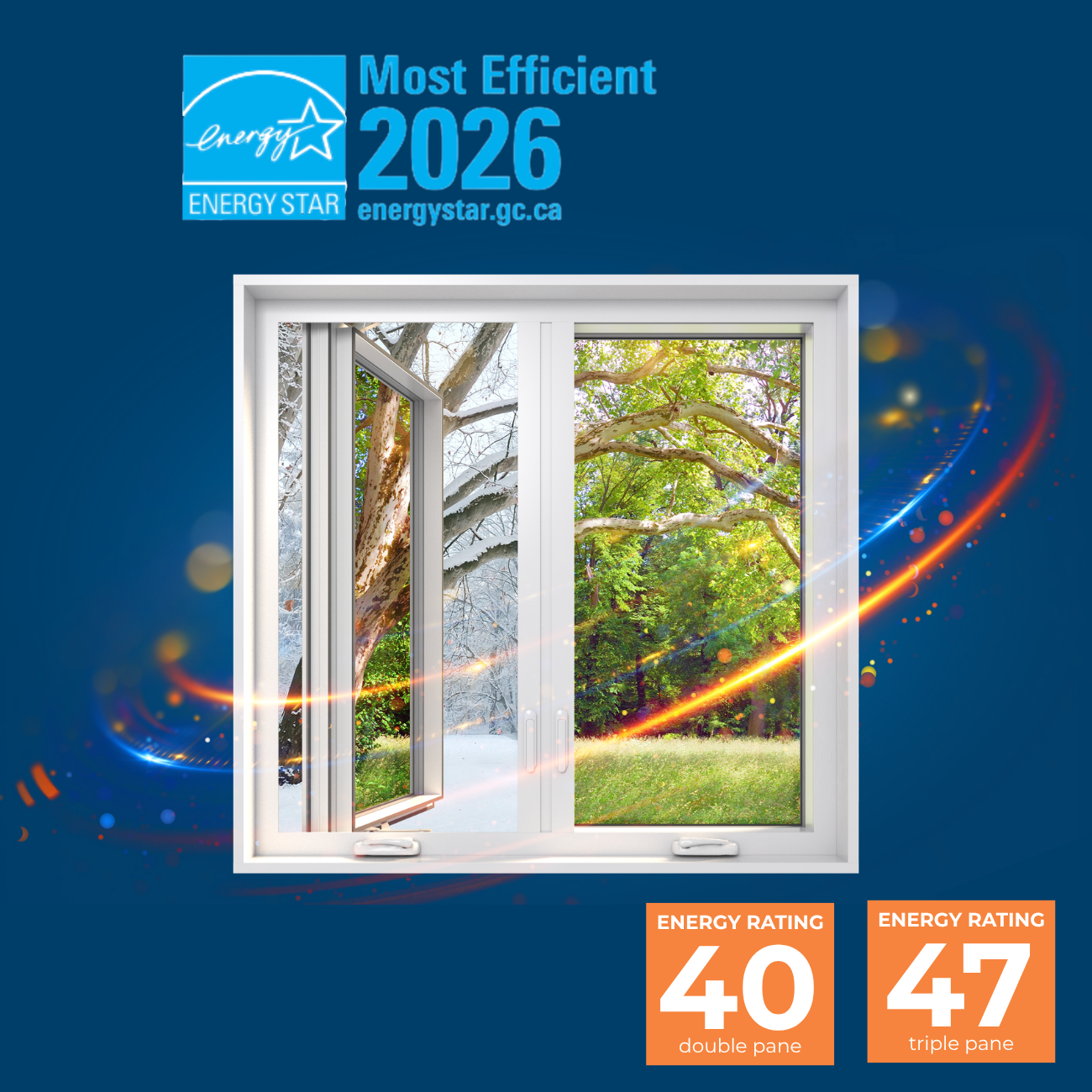
A well-built casement, like Verdun's RevoCell® windows, achieves a high Energy Rating (ER) score of 40 on double-pane and 47 on triple-pane. Both are ENERGY STAR® Most Efficient certified, the highest rating Natural Resources Canada hands out. The solid-core microcellular PVC frame is a big reason why. It's engineered with billions of microscopic air bubbles that act as buffers to reduce temperature transfer. This means they outperform the standard hollow vinyl windows.
This is what matters the most in Ontario weather. When you're paying hydro bills in February or August, a properly sealed window is a big deal that can help improve your energy efficiency.
What makes casement windows worth it and what to keep in mind
Casements have a lot going for them, and the list speaks for itself.
What we love about them:
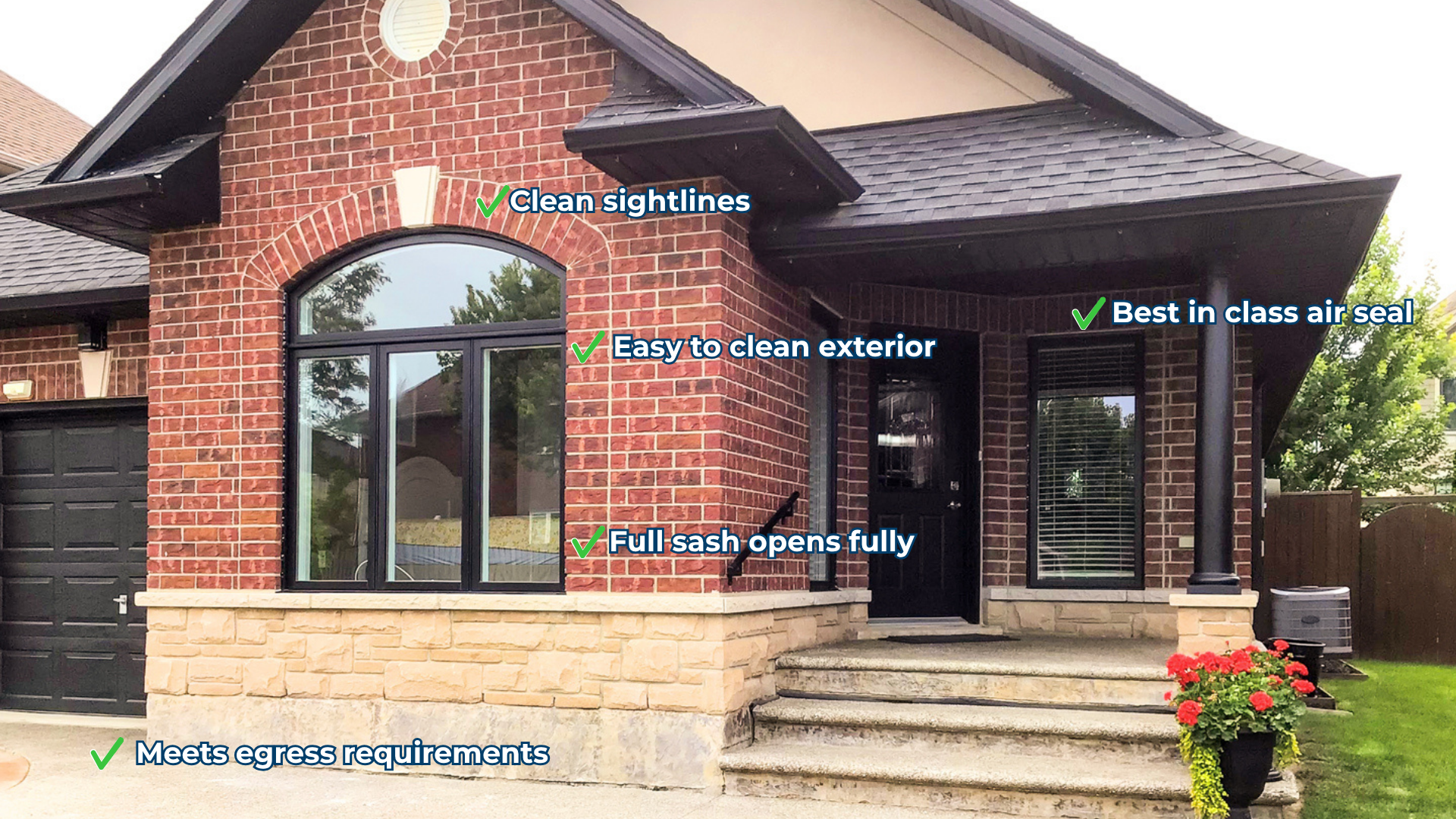
- Best in class air seal — the compression seal on all four sides is genuinely superior
- Full sash opens completely, giving maximum airflow, not just a partial crack
- Easy to clean the exterior glass from inside, no ladder required
- Clean sightlines with no horizontal rail breaking up your view
- Meets egress requirements in most sizes
A couple of things worth knowing:
- Opens outwards, so clearance matters. If your window sits directly above a walkway, deck railing, or busy area, you need to think about swing direction before you commit
- Like any mechanical component, the crank operator benefits from a little annual maintenance. A quick lubrication once a year is really all it needs to keep working smoothly for years
How to Maintain Casement Windows
The good news is that casement windows are genuinely low maintenance, especially when they're built with RevoCell®. The solid microcellular PVC resists moisture and weather damage naturally, so occasional cleaning is really all it takes to keep them looking and performing great for years.
The operator is the crank mechanism, the handle that makes a casement a casement. It's also where most problems start. A stiff crank is usually either a lubrication issue or a worn-out operator.
Keep it lubricated annually and check that the weatherstripping is compressing evenly when the window closes. However, if anything ever does come up beyond regular maintenance, our 25-year No-Bull Warranty has you covered.
- Noticing other things happening with your windows? Read more on some of the signs your windows may need replacing.
You can also book an appointment with our team for a free home assessment that can tell you exactly where things stand with no guesswork and no pressure.
How to Clean Casement Windows (Including the Exterior) From the Inside
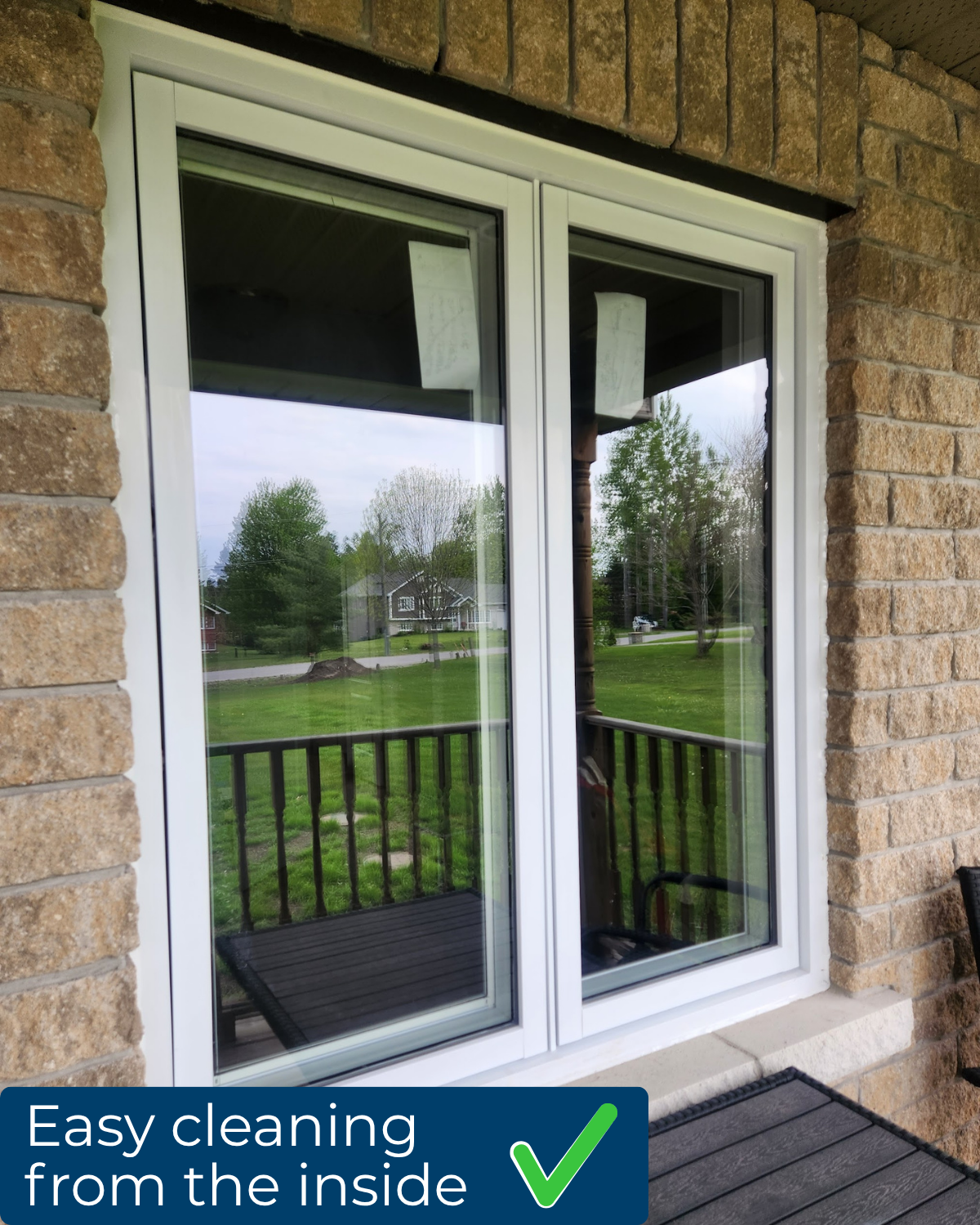
If you have a single or double casement window, it's quite easy to clean it even from the inside. The sash hinges on the side, so when you crank it fully open, it swings outward far enough that the outside surface of the glass is within arm's reach — all from inside your home. No ladder or awkward leaning. It's one of those things that sounds too good to be true until you actually do it.
Fixed casement windows don't open, so the exterior glass needs to be cleaned from outside. A ladder or a professional cleaner is usually the right move. Awning-style casements give you some access since the bottom swings out, but the top of the glass may be tough to reach depending on where you have it installed in your house.
Be careful cleaning around the weatherstripping. It's what makes your casement seal the way it does, and it doesn't respond well to abrasive cleaners, scratchy cloths, or petroleum-based products. Any of those can degrade the material over time and the seal suffers quietly long before you feel it. If your weatherstripping is looking worn or compressing unevenly, get it looked at sooner rather than later.
What to Look for When Buying Casement Windows in Canada
Ontario's climate is genuinely demanding. Cold winters, hot summers, humidity in July, your windows take a beating year-round. Here's what actually matters when you're shopping for casement windows:
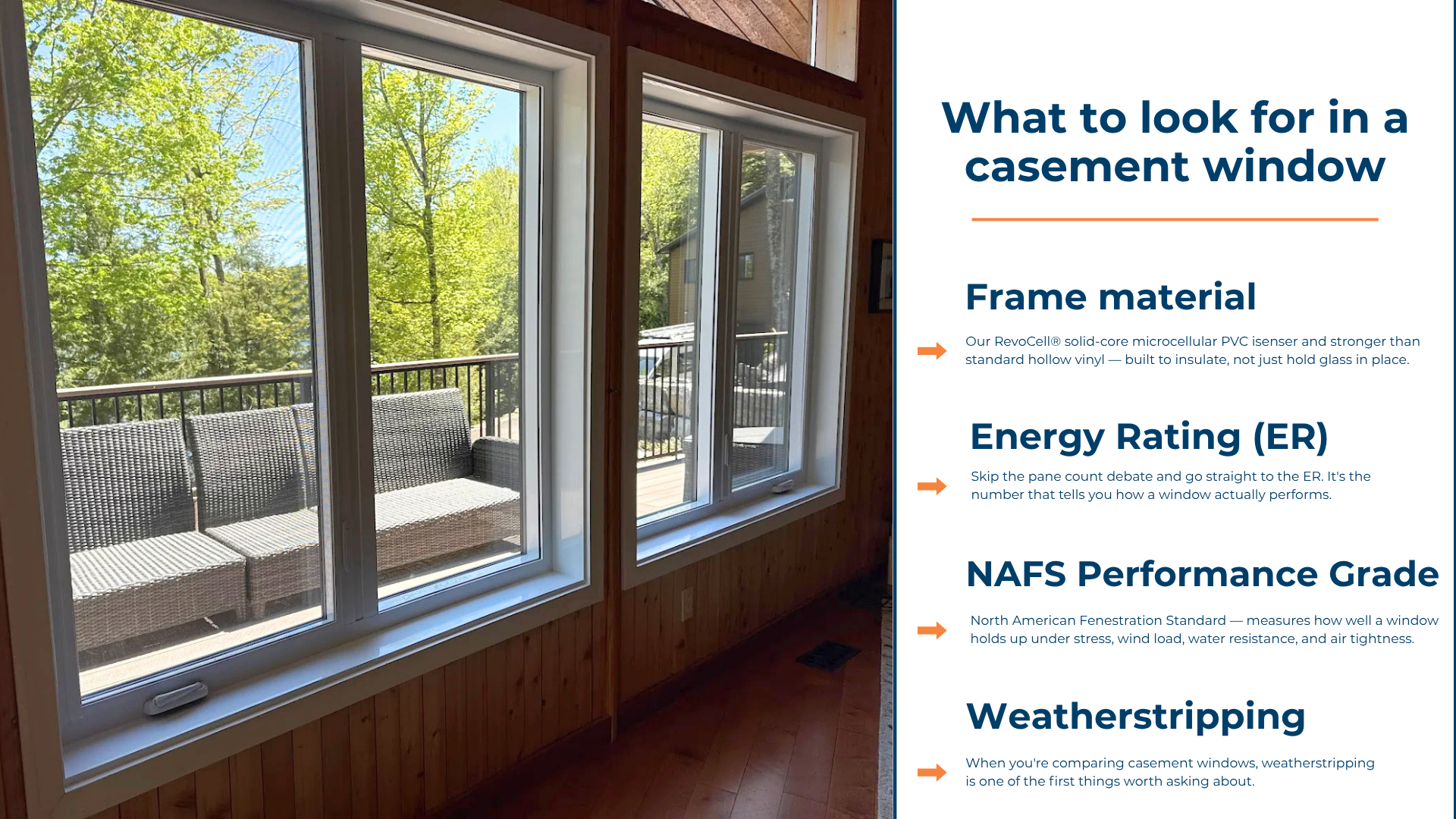
- Frame material: The frame is doing more work than most people give it credit for. Standard hollow vinyl can get the job done, but our RevoCell® solid-core microcellular PVC is denser, stronger, and built to insulate rather than just hold the glass in place.
- Energy Rating (ER): Skip the pane count debate and go straight to the ER. It's the number that tells you how a window actually performs. Our RevoCell® casements hit ER 40 on double-pane, which beats industry standards and many triple-panes on the market. This is ENERGY STAR® Most Efficient, Canada's top designation, which means you get top-efficiency without the premium. However, if you have the budget and are still looking for triple-pane, our casement windows hit an ER of 47 in standard configuration.
- NAFS Performance Grade: NAFS — North American Fenestration Standard — measures how well a window holds up under stress, wind load, water resistance, and air tightness. Our RevoCell® frames are solid inside rather than hollow, and every window comes standard with a 4.5" deep frame, 38% deeper than the industry standard of 3.25". That extra depth and density is what gets our casement windows to a Performance Grade of 85, well above the industry average of 60.
- Weatherstripping: When you're comparing casement windows, weatherstripping is one of the first things worth asking about. Double weatherstripping is common, but triple is where the real difference shows up. At Verdun, that's exactly what you get — two inner compression seals that create a proper airtight barrier, plus a third outer seal that acts as a dust guard. Standard on every casement we make.
Other factors to consider include your home's layout, exposure, and what you're actually trying to solve. A conversation with a window expert can help you find the right solution for your home.
We at Verdun offer free in-home consultations. No pressure, just an honest look at your windows and a clear recommendation. With Canadian-made products, full installation, and a 25-year warranty that's one page with no fine print, we make the process easy and straightforward.
Frequently Asked Questions
What's the difference between casement and hung windows?
On casement windows, the whole sash opens for optimal ventilation. When closed, it presses against the frame on all four sides, giving it an airtight seal, which is why they tend to win on energy efficiency. A hung window has one sash (single-hung) or two sashes (double-hung) that slide vertically, and neither opens the full frame. The seal is a sliding rather than a compression fit.
The popularity of hung windows comes down to practical spatial considerations. In smaller spaces or where a window faces an exterior sitting area like a deck or porch, a casement's outward-swinging sash simply isn't an option. Hung windows are easier to do a partial replacement on, which is part of why they've stuck around so long.
At Verdun, our RevoCell® mPVC standard configuration casement and hung windows hit an ER of 40 in double-pane windows. They are both certified ENERGY STAR® Most Efficient, which makes them both solid choices depending on the needs of you and your home.
What's the difference between casement and awning windows?
Awning windows are hinged at the top and open from the bottom, which is essentially a top-hung casement. Standard casements hinge on the side. Awnings are the better call for rain-day ventilation, but casements give you more total airflow. However, you can see them both used together in many installations.
Can a casement window be used as an egress window?
In most cases, yes. Canadian building code requires a minimum clear opening of 0.35 m² with no dimension less than 380mm. Most standard casements meet this, but always confirm the specific unit specs and building code before relying on it for egress compliance.
Do casement windows come with screens?
Yes, and honestly the placement works in your favour. Since the sash opens outward, the screen lives on the interior. It's easy to access, clean, and remove when you don't need it.
At Verdun, we also offer flex screens with a thinner frame that blends seamlessly with the window from the outside. As for mesh, fibreglass is softer and less likely to tear, while aluminum is more rigid and pet-resistant. Two good options depending on what your household needs.
Can casement windows open inward?
Standard casements in the Canadian market open outward. Inward-opening casements exist; however, they're more common in European designs and not typical here in Canada.
How big can casement windows be?
Most manufacturers support single casement widths up to about 36 inches and heights up to 80 inches, based on square footage and location. Larger openings are typically handled with a double casement or a combination configuration.
About Verdun
Verdun Windows & Doors has been manufacturing and installing windows and doors for Ottawa and Gatineau homeowners for over 40 years. Every product is custom-built in Canada, every installation is managed by one accountable team from start to finish, and every job is backed by the 25-Year No-Bull Warranty, covering product, parts, labour, and installation with no fine print.