Written by: Alec Bigras
Reviewer: Editorial TeamA quote lands in your inbox, and it's full of words you've never had to know before: jamb, sill, sidelite, transom. This vocabulary usually isn’t common knowledge, and a lot of sales reps don’t explain them when they’re giving you a quote.
In this blog, we name every part of an exterior door and its frame, show exactly where each one sits, and clear up the handful of terms people mix up most. By the end, you'll be able to read a door quote line by line and know exactly what you're looking at.
Parts of a Door at a Glance
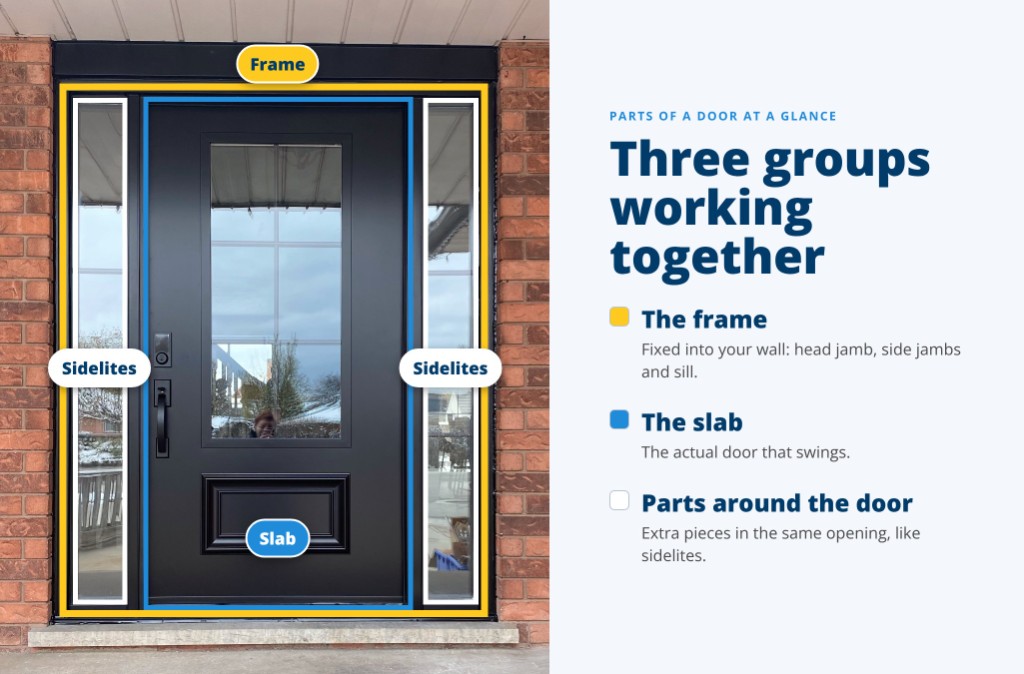
To make things simple, an exterior door is really three groups of parts working together: the frame that's fixed into your wall, the slab (the actual door that swings), and a few extra pieces that sometimes surround the opening, like sidelites and a transom.
Here's every part in each group:
Parts of a Door Frame
Head jamb
The head jamb is the horizontal piece at the very top of the frame, running side to side above the door slab. In our catalogue, you’ll see it's called the header. The top edge of the slab closes against it, and on our steel entry doors, magnetic weatherstrip runs along it.
Side jambs
The side jambs are the two vertical pieces running up each side of the frame, connecting to the head jamb at the top. The one with the hinges is the hinge jamb, and the other is the latch jamb, where the lock latches. Together with the head jamb, they form the three-sided door jamb, the structural frame the door slab hangs and closes into.
Want to know about what goes into that lock? Read our guide to types of front door locks.
Sill
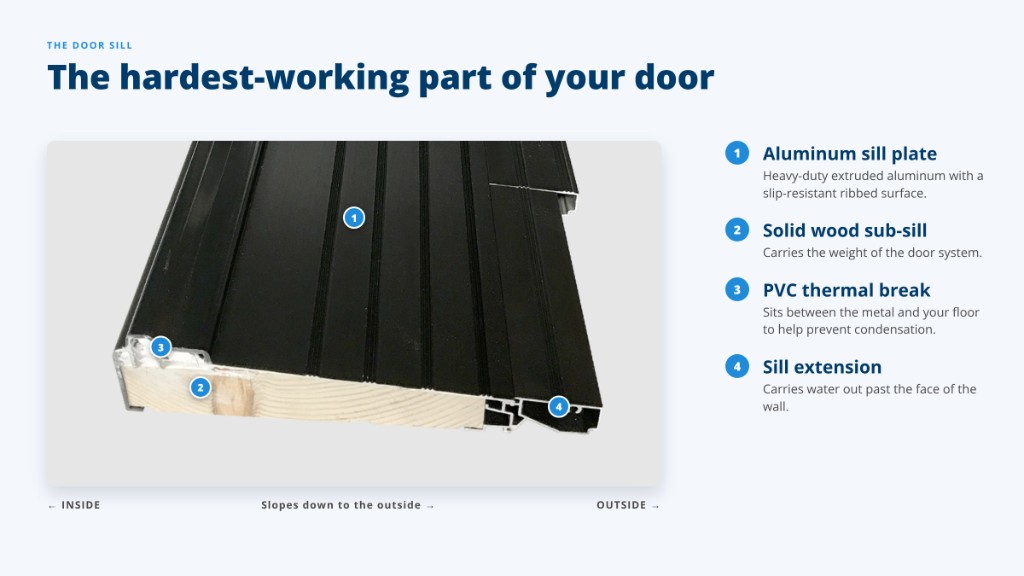
The sill is the horizontal piece at the very bottom of the frame, the part you step over. On an exterior door, the sill is sloped slightly to direct water away from the house.
Ours is a heavy-duty extruded aluminum sill plate with sill extensions and a slip-resistant surface, sitting on a solid wood sub-sill that carries the weight. A PVC thermal break sits between the metal and your interior floor to help prevent condensation.
Parts of the Door Slab
The door slab is the actual door, the part that swings on hinges. It has its own set of parts, most visible on panel-style doors.
Stiles
Stiles are the vertical edges of the slab , the left and right sides. Think of them as the door’s side borders.
Rails
Rails are the horizontal pieces across the door, at the top and bottom (and sometimes in the middle). A quick way to remember: stiles stand, rails run across.
Panels
Panels are the flat or raised sections between the stiles and rails. They give a door its pattern. On a 6 panel door, those six rectangles are the panels.
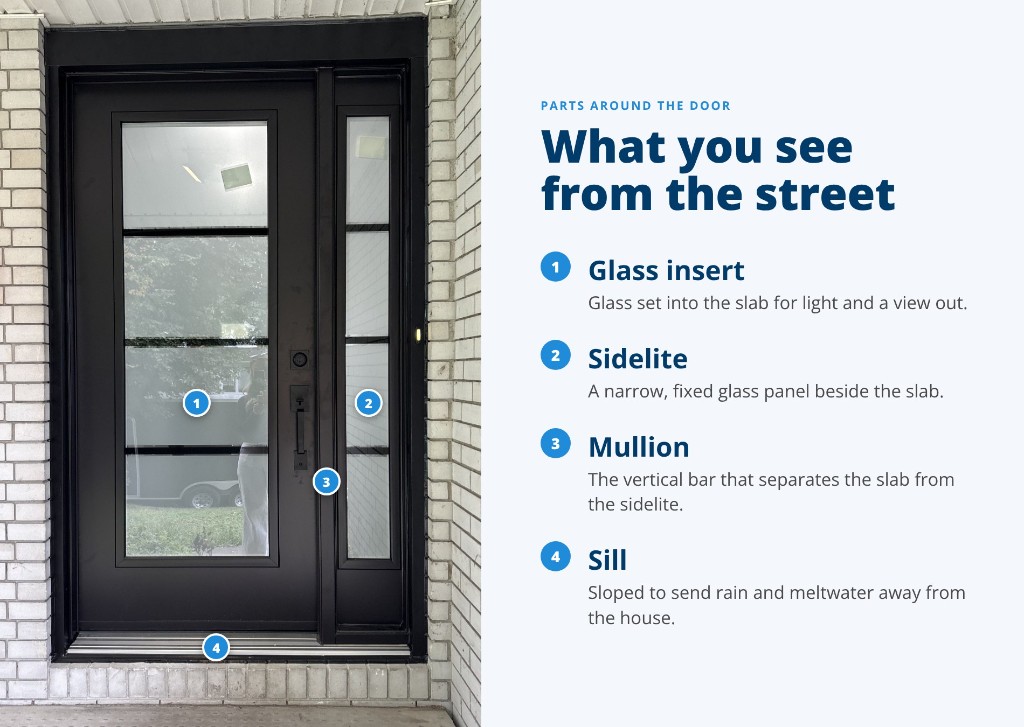
Glass inserts
Glass inserts (also called door glass) are the glass set into the slab. They let natural light inside and give you a view out, and they range from fully clear to fully private. Glass mouldings frame the glass: Colonial mouldings suit Prestige and Classic slabs, while smooth, low-profile mouldings suit Shaker and Contemporary ones.
Parts Around the Door
Some entrances have extra pieces beside or above the door itself, like panels of glass. They aren’t the door, but they’re built into the same opening and ordered as part of your door system.
Sidelites
Sidelites are the narrow, fixed glass panels installed on one or both sides of the main door slab, adding natural light and width to the entryway without functioning as their own doors.
Transom
A transom is a fixed window positioned above the door, letting in extra light above the entryway without compromising safety or privacy. Transoms are typically found on homes with 9-foot or higher ceilings.
Mullion
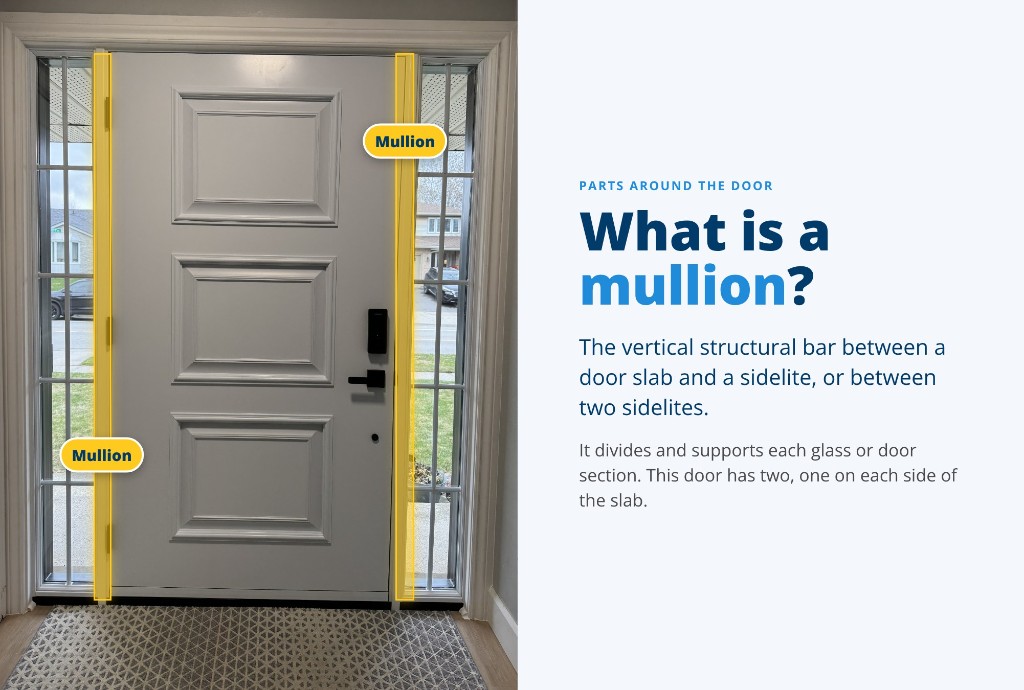
A mullion is the vertical structural bar separating a door slab from an adjacent sidelite, or separating two sidelites from each other. It's what physically divides and supports each glass or door section within a larger door system.
Door Jamb vs Door Frame: What's the Difference?
This is the single most confusing part of door vocabulary, and the reason it's confusing is that these two words mean almost the same thing.
What is a door jamb?
A door jamb is the part of the frame the door hangs from and closes against. There are three: the head jamb across the top and a side jamb down each side.
Door jamb vs. door frame
There’s essentially no difference. People use the two words to mean the same thing, so you can treat them as interchangeable on a quote.
Is it "door jam" or "door jamb"?
It's spelled "jamb," with a silent B, though "door jam" is an extremely common misspelling, one many homeowners search for without realizing. Both spellings mean the same thing.
The Door Sill: What It Does and Why It Matters in Winter
The sill is the hardest-working part of your door, and the one nobody thinks about until there’s a draft or a puddle at their feet. It gets stepped on, snowed on and salted, and it still has to keep the winter out.
Why the difference matters in winter
In a Canadian winter, the sill is doing real work: directing rain and melting snow away from the door, resisting ice buildup, and maintaining a tight seal with a door sweep that has to perform through big temperature swings. A sill that isn't sloped properly, or a sweep that's worn or poorly adjusted, is a common source of drafts and water intrusion at the bottom of an exterior door, exactly where it's hardest to notice until it's already a problem.
Other Parts That Keep an Exterior Door Weather-Tight
A door's ability to keep cold air, drafts, and water out comes down to a few specific parts working together.
Weatherstripping
Weatherstripping is the flexible sealing material applied around the door stop and sometimes the threshold, compressing when the door closes to block air and water infiltration. It's one of the most common points of failure on an older door, and one of the easiest things to inspect yourself.
Door sweep
The door sweep is a strip attached to the very bottom of the door slab. It directs rain to the sill, instead of toward your floor so it's your main defence against drafts and water right at floor level.
How the sill, weatherstripping and sweep work together
None of these parts function well in isolation. The sill directs water away from the door, weatherstripping seals the sides and top, and the sweep seals the bottom. If even one of these is compromised, cold air and moisture will typically find their way through, which is exactly why a proper door replacement addresses the whole assembly, not just the slab.
Door Terms You May See on a Quote
A few more terms show up specifically in the buying and installation process, separate from the physical parts of the door itself.
Door system
The door system is the complete unit built for your opening: the slab, jambs, sill, weatherstripping sweep and hinges, plus any glass, sidelites or transom you’ve chosen. refers to just the door itself, the swinging panel, without the surrounding frame.
Door slab
The door slab refers to just the door itself, the swinging panel, without the surrounding frame. When you see "slab only" pricing on a quote, it means the frame isn't included.
Rough opening
The rough opening is the bare hole in your wall before any door goes in. Your new door system is installed into it, so its measurements decide what size door fits.
The Bottom Line
That's the full vocabulary, frame to slab to everything in between. The next time a quote mentions the sill, the sweep or a sidelite, you'll know exactly what's being talked about, and exactly what you're paying for.
Thinking about a door replacement? Book a consultation and we'll walk you through exactly what your door system will include, using the same terms you just learned.
Related reading: Curious about the same kind of breakdown for your windows? See our companion guide: Parts of a Window.
Frequently Asked Questions
What are the main parts of a door called?
The main parts of an exterior door are the frame (head jamb, side jambs and sill), the slab (stiles, panels and glass inserts), and, where applicable, surrounding pieces like sidelites and a transom.
What are the parts of a door frame called?
A door frame is made up of the head jamb (top), the two side jambs (the hinge jamb and the latch jamb), and the sill (bottom). Brickmould finishes the outside of the frame.
What is the difference between a door frame and a door jamb?
In practice, these two terms are used interchangeably by most contractors and manufacturers. Where a distinction is made, "door jamb" refers specifically to the head and side jamb pieces the door hangs from and closes against, while "door frame" is sometimes used as the broader term for the full frame assembly.
What is a door sill?
The sill is the sloped base of the door frame. It supports the door, and on an exterior door it directs water away from the house.
What is a transom on a door?
A transom is a fixed window above the door that brings in extra natural light without compromising safety or privacy. It's most common on homes with 9-foot or higher ceilings.
About Verdun
Verdun Windows and Doors has been manufacturing and installing windows and doors for Ottawa and Gatineau homeowners for over 40 years. Every product is custom-built in Canada, every installation is managed by one accountable team from start to finish, and every job is backed by the 25-Year No-Bull Warranty, covering product, parts, labour, and installation with no fine print.